Paradise Falling
Updated: Jan 26
From the Star Goddess Down to Earth’
The general name for the mystics who pondered on the cosmos, creation and the ‘nature of reality’ is the ‘Gnostics’. One important source for Gnostic teachings came from a series of manuscripts called the Nag Hammadi texts and the Dead Sea Scrolls, found near the town of Nag Hammadi about 75-80 miles north of Luxor on the banks of the River Nile, in Egypt. These texts generally became known as the ‘lost gospels’ of the Nag Hammadi Library. The Nag Hammadi discovery included thirteen leather-bound papyrus codices (manuscripts) and more than fifty texts written in Coptic Egyptian, the work (along with other ancient influences) of a people known as Gnostics. The Gnostics were not a racial group; their ideology was a way of ‘perceiving reality’ under the heading of ‘Gnosticism’, coming from the term Gnosis - a Greek word that translates as ‘secret knowledge’. To be Gnostic, in simple terms, meant to be ‘learned’.
The Aeons (Higher Consciousness)
The Gnostic Nag Hammadi texts offer an alternative creation story teaching of a cosmological ‘birthing’ of our world through dreaming of what the texts refer to as the ‘Aeons’. According to Gnostic thought, the Aeons were divided into Upper and Lower realities (states of consciousness) and one particular Aeon, called Sophia, was pivotal in their creation story. Sophia was the goddess that became Gaia, or Earth, in the Gnostic teachings. Dictionaries define this meaning of Aeon as a power existing from eternity; an emanation or phase of the ‘supreme deity’. Gnostic texts refer to the Upper Aeons and Lower Aeons in very different terms and they say that between two worlds is a curtain, veil, or boundary (see image below). The Upper Aeons are said to emanate directly from the unity of ‘The One’ – Infinite Awareness of itself – and can be symbolised as concentric circles expressing the Oneness of their Creator, or Emanator.

In my book Journeys in the Dreamtime (2022), I refer to the Pleroma as the ‘mother substance’ and the ‘source of all light’. In the ancient Judaic texts, The Book of the
Mystery and the Kabbalah, the divine substance is personified as the most ‘ancient of ancient’. Manly P Hall, Freemasonic Historian and author of The Secret Teachings of All Ages (1928), quite rightly refers to ‘Superconsciousness’, or the Aeons, as having both male and female personage. In the Hebrew Bible, ‘wisdom’ (Chokhmah) relates to a ‘Divine Unity’ evident in the Gnostic teachings; the Higher Aeons, male and female, wisdom and intelligence ‘combined’ (symbolised as the snake), were said to have created the world. One text in the Book of the Mystery reads:
From the bosom of this absolute Unity, distinct from the various forms and from all relative Unity, go forth, as parallels, two principles, opposite in appearance but inseparable in reality; one, male or active, which is called "Wisdom,” the other passive, or female, is designated by a word which it is customary to translate by "Intelligence".1
The female divinity in such passages refers to ‘Sophia’ in Gnostic belief. She is the creator of worlds affecting our reality and as the Zohar states:
Wisdom is also named the "father"; for it is said, Wisdom engenders all things. By means of thirty-two marvelous ways by which it is diffused through the universe, it imposes a form and measure on all that is. Intelligence is the "mother," as is written: Thou shalt call intelligence by the name of mother.
Sophia, Mother Nature & the Starry Night
The two-thousand-year-old Nag Hammadi texts say the Aeons were separated from their celestial region by Horus (or Boundary) and beyond its veil was what the Gnostics called the ‘Kenoma’, or the ‘void’ (worlds beyond spirit). Humanity was said to have been created out of the meeting of the ‘Kenoma’ and the Aeon Goddess, Sophia. It was thought by the Gnostics that humans are god-like (Aeon-like) with a powerful tool at their disposal – ‘divine Imagination’ (see Through Ancient Eyes). In the Nag Hammadi texts, the Aeon called Sophia (wisdom in Greek), aided by Thelete (intent in Greek), was said to have dreamed into existence a world connected to the Upper Aeons but formed in worlds connected to the Lower Aeons. Sophia became self-awareness and through her dreaming process, into the realms of the Kenoma (beyond the veil), she created what the Aboriginal cultures call the ‘Dreamtime’ – a creation epic predating all biblical creation narratives by at least tens of thousands of years.
The Goddess of the ‘Light’ – the Wife of God
The Goddess Gnowee (the torch carrier), of the Wotjobaluk Aboriginal people, was also another version of Sophia. The Freemasonic version of this torch-carrier is the Statue of Liberty of Isis (Liberty Enlightening the World). Mythologically, the Goddess Isis was the
eldest daughter of Saturn, wife of Osiris (Orion) and symbolic of the Dog Star, Sirius. The Goddess and legendary ruler Tomyris (‘Queen of the Scythians’) of the Massagetae people, seems to be connected to the Phoenician and earlier shamanic female warriors - the Amazons. Ancient Amazons, hunters, the hunter, Orion and the many modern-day corporations, names and logos, are all connected symbolically. Another aspect of Sophia can be found in the stories of Asherah, the ‘Wife of God’ found in Mesopotamian art and sculpture. The famous 25,000-year-old Neolithic sculpture of the ‘Venus of Dusseldorf’ is another image of Asherah, or possibly, Sophia. In American Indian belief, there is also a ‘Yei’ (divine form) called ‘Ahsonnutli’ or ‘Etsanatlehi’, which means ‘woman who changes’. Also called ‘Changing Woman’, she was one of the principle creation spirits (or Aeons) that formed the sky and the earth (see also the Egyptian goddess, Nut).
Sophia’s Dream Turned Nightmare.
It is said that Sophia ‘absorbed herself’ in her fascination for the Anthropos and her dreaming, where she ‘fell’ further into the ‘void’ or the ‘Kenoma’. Here she awoke from within what seemed to be a nightmare as she drifted further away from the Pleroma and Upper Aeons. The Gnostics say Sophia impacted on the outer veil (the boundary) and ventured into the realms of chaos, her ‘living consciousness’ led to the ‘emergence’ of what Gnostic texts call ‘inorganic’ elementals. These are the ‘Archons’ mentioned in previous chapters. In Arabic texts the same elementals are called the Jinn (genies), and in Christianity they are referred to as demons or ‘phantoms’. The word Archon comes from the Greek ‘archai’, which means primordial, first, or antecedent in time. The texts describe how the Archons arose in the planetary system before earth was formed into a habitat for life; they are not organic by nature. In truth, these ‘entities’ are both good and bad and are also the angelic beings and the Watchers I mentioned in the last chapter. The arrival of the archons into the void was said to be a ‘plague’ on the Anthropos and therefore humanity. We are still suffering from this plague. The arrival caused chaos in all matters of the human mind. Sophia’s impact on the boundary-between-worlds also created a cosmic calamity as these inorganic Archons circled and swooned around the chaos that was formed by Sophia’s ‘fall’ into the Kenoma (see figure below). The story in itself is mirrored in so many indigenous myths that relate to the ‘splitting of the supreme being’ and the ‘duality of life’ that ensued from this splitting.

On one level, you could say that Sophia fell into a ‘coma’, a place from which she would eventually awaken, but her wanderings in the Pleroma set in motion a creation epic. Some texts, such as the Apocalypse of Adam, say that Sophia, as one of the nine muses, ‘solidified’ her attention, eventually becoming the Earth. One text in the Gnostic Bible reads:
From the Nine Muses, one separated away. She came to a high mountain and spent (some) time seated there, so that she desired herself alone, in order to become androgynous. She fulfilled her desire and became pregnant from her desire.
The texts here refer to an aspect of Sophia becoming the Anthropos (celestial humanity) or giving birth to the light (divine imagination) that would become what visionaries, like William Blake, called the ‘Human Form Divine’.
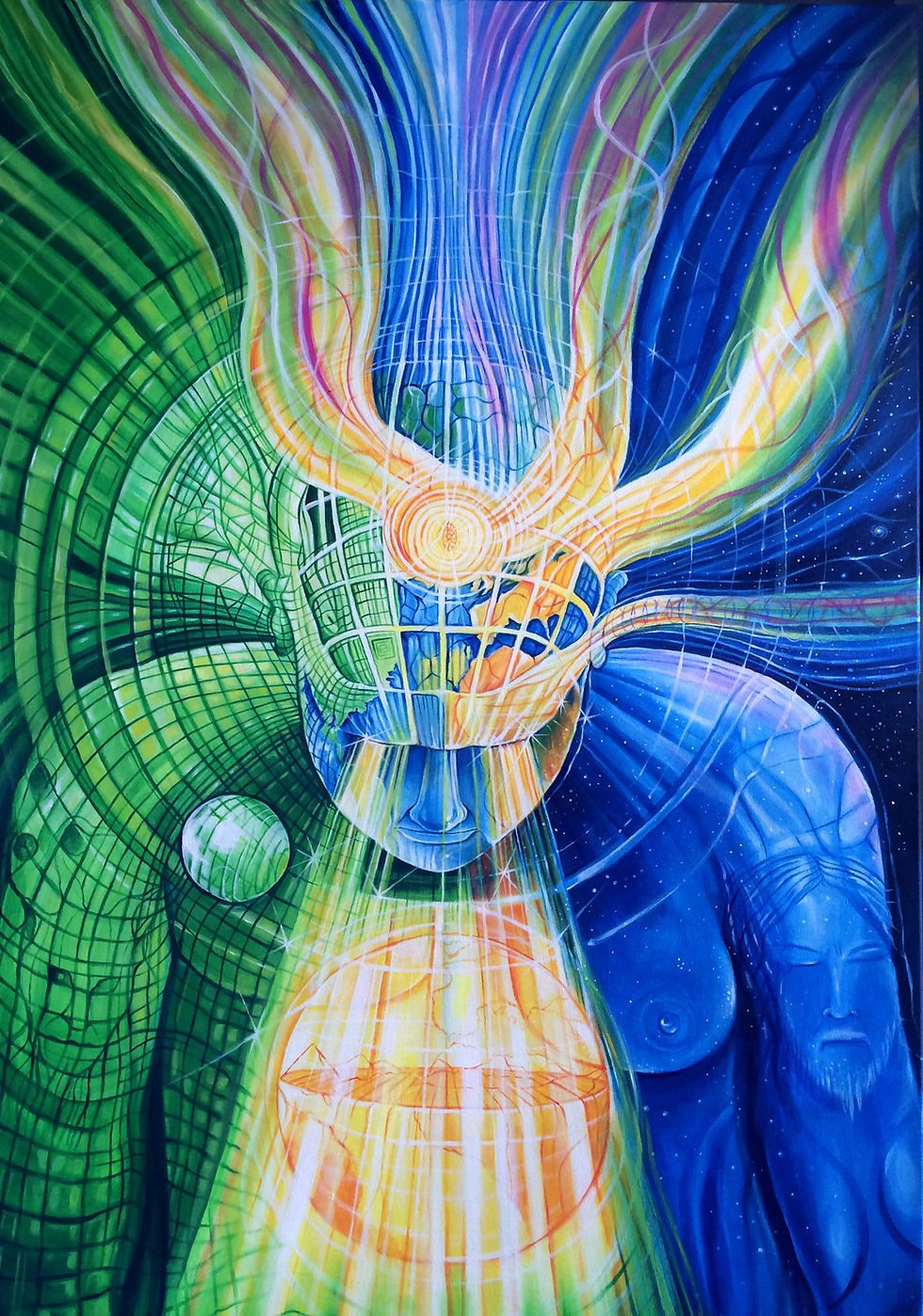
Virtual Heaven
According to Gnostic myth, the world humanity inhabits is pure ‘thought’, the region of matter made manifest through the material (physical) world. This philosophy was the foundation of the Gnostic groups that became the Tenth Century ‘Bogomil’ and ‘Paulicians’, through to the 12th Century Cathars of Occitania, France. They all saw the physical world as the land of shadow and darkness, a place where ‘perception and deception’ would coexist. The material world was always imperfect and unchangeable for the Gnostic dualist faith, and only spirit should be sought. The Aeons was the home, or sanctuary, for those that lived in the light. According to Gnostic texts, Sophia eventually ‘changed’ and took physical form as Gaia (the original Earth) so to allow those that would be born into the physical world to find comfort in the light of the goddess. Sophia was personified as Mother Nature and the key to living in harmony as a human being. Look how far we have come from this understanding today? The Northwest Thompson Indians, an Indigenous First Nations people in southern British Columbia, illustrate a similar story of the Earth as a goddess through their cosmology:
At first Kujum-Chantu, the Earth, was like a human being, a woman with a head, and arms and legs, and enormous belly. The original humans lived on the surface of her belly. Her hair became the trees and grass; her flesh, the clay; her bones, the rocks and her blood, the springs of water.2
From my research, I feel that Sophia was captured in art forms found all over the ancient world as the original goddess. She is ‘Langa’ to the Zulu African; to the Aztec, she is the goddess ‘Chalchiuhtlicue’. We find many personifications of this Aeon Goddess; as previously mentioned, she is the goddess Umai; Asherah, the Wife of God, found in Mesopotamian art and sculpture. Eve, in my view, was another version of Sophia. The ‘lioness’, ‘dragon’ and ‘bird’ in my painting, Eve and Adam in the ‘garden in the Stars’, are all projections of the goddess who lives in the light, forming in the garden amongst the stars (see figure below). The garden is located in the Orion Nebula.

The lioness and the dragon bird are intricately connected to our DNA, including so-called junk DNA. The god in the upper right section ‘holding’ the Anthropos (the first human being, also referred to as Adamas, or Geradamas) is symbolic of the Elohim, more on them shortly. You will also notice from my painting above that the goddess Eve is already in the
Garden of Eden. According to Gnostic teachings, the spirit of Eve was already in the garden and was referred to as ‘Zoe’ (life itself). Zoe is a daughter of Sophia and a teacher for the first man - Adam. Zoe, or Eve’s spirit, entered the Tree of Life and eventually became symbolised as both the ‘serpent’ and the ‘apple’ in Genesis. All of this was said to have occurred after Sophia’s nightmare and primary birth. Zoe, or the ‘Spirit of Eve’, according to the Secret Book of John (also known as the Apocryphon of John), was said to have become the tree to hide from the Archons. The Apocryphon of John elaborates on this narrative:
A light-filled Afterthought emerged, and he called her Zoe (Life). She aids the entire creation, working with him, restoring him to the Fullness. She taught Adam about the way his people had descended. She taught Adam about the way his people could ascend, which is the way he had descended. The light-filled power was hidden in Adam, so that the rulers wouldn’t know about Her. For [Zoe/Spirit of Eve] would repair the damage her mother had caused.
Sophia, Orion and the Milky River
Sophia, being so in awe of the realms of the Upper Aeons, ‘dreamed into existence her own world’ without consent from the Infinite. From within Sophia’s dreaming-turned nightmare, according to Gnostic scriptures, there appeared a central figure, or a deity to which she gave birth, then quickly rejected. This unwanted child grew to become the arrogant god-figure we recognize in the books of the Old Testament. Like a child, this figure arrogantly proclaimed itself to be the ‘source of all that was’ born of the impact on the Pleroma caused by Sophia’s dreaming. For the Aramaic Gnostics, this ‘ruler’ became known as ‘Yaldabaoth’ (the blind ‘announcer’), or the Father God ‘architect’ who manufactured a ’fake system of worlds’. In Aramaic, his name was ‘Saklas’, meaning ‘fool’, another symbol for Orion (see my book Orion's Door).
(extracts from Orion's Door) To be continued ...
Notes:
2) Long, Charles H. Alpha: Myths of Creation, 1963. pp 36-37


Comments